At CinemaCon 2026, Steven Spielberg took the stage to promote his upcoming sci-fi thriller Disclosure Day, but he found himself speaking to something larger than any one film.
Looking out at a sea of exhibitors, he laid the industry's ultimate problem bare:
"If all we make is known, branded IP, we're going to run out of gas. [...] There is nothing more important than giving the audience visual stories, and they can be in any form, but we need to tell more original stories."
— Steven Spielberg, CinemaCon 2026
Later in the session, Spielberg commended Universal's Donna Langley for committing to a 45-day theatrical window. According to trade reports, he then speculated aloud whether the industry might stretch those windows to 60 days, or even double that. It was a rallying cry for the cinematic experience, pushing back against a landscape increasingly dominated by streaming.
Why is the man whose direction of Jaws in 1975 practically invented the modern blockbuster suddenly sounding the alarm about franchise fatigue and distribution models? The answer lies not in a lack of creative filmmakers, but in the corporate structures that employ them. Spielberg is identifying a modern symptom, but the underlying disease was diagnosed over forty years ago.
To truly understand the root of Spielberg's frustration, we need to look past Hollywood trades and turn to the work of British media theorists James Curran and Jean Seaton.
Whilst they aren't studio executives, Curran and Seaton are among the most influential figures in the political economy of media. Curran is Emeritus Professor of Communications at Goldsmiths, University of London; together, they have co-authored and edited the field's most widely assigned text. Since the first publication of Power Without Responsibility in 1981, now in its 9th edition and a fixture on media studies syllabuses for four decades, they have studied how corporate ownership dictates cultural output. Their core argument provides the ultimate decoder ring for the streaming era: who owns the media determines what we see, what is preserved, and what is allowed to exist. When we apply their academic lens to modern Hollywood, the trends Spielberg is warning us about stop looking like accidents and start looking like inevitabilities. This piece traces that argument from its theoretical roots through the legal history that enabled the current concentration of power, and into the regulatory frameworks, and their limits, that now represent our best attempt at a response.
Why a handful of studios control what you watch
Curran and Seaton argue that media industries follow the same capitalist path as any other industry: Concentration. Over time, smaller companies are swallowed by larger ones until only a handful remain. Today, a small group of major studios commands the vast majority of the US box office: Disney, Warner Bros. Discovery, NBCUniversal, Sony, and Paramount, which completed its merger with Skydance in August 2025. The precise market share shifts year to year, but the structural reality is consistent: a handful of conglomerates control what gets made and how it reaches us.
This concentration of power happens through two main mechanisms. The first is horizontal integration: buying out competitors to eliminate rivalry and absorb their market share, as Disney did when it purchased 21st Century Fox. The second runs deeper.
Vertical integration is when a single company controls every stage of a film's life, from development and production through to distribution and the screen on which you watch it. This is where the streaming era marks a genuinely new chapter in what Curran and Seaton originally observed. When Netflix funds a film, markets it, and acts as the primary venue where audiences can access it, they don't just make the product; they own most of the pipeline. It is true that for certain prestige titles (Roma, The Power of the Dog, films chasing awards attention), platforms have negotiated short theatrical windows with exhibitors. But these are strategic exceptions, not structural commitments. The default model is one in which there is no competing distributor to push back on release decisions, no standing theatrical obligation, and no external party to retain rights. The vertical integration that once required three separate companies now fits, by default, inside a single app on your phone.
When ownership is concentrated in so few hands, the primary goal shifts from artistic expression to the logic of profit and power.
The rules that were supposed to stop this
What is easy to forget is that this kind of vertical integration was, not so long ago, illegal.
In 1948, the US Supreme Court ruled against the major Hollywood studios in United States v. Paramount Pictures, Inc., a landmark antitrust case that found the studios' ownership of first-run theatres in major urban markets, combined with practices like block booking, constituted an illegal monopoly over the most lucrative portion of the exhibition pipeline. Block booking forced exhibitors to take entire slates of films from a studio in order to secure the titles they actually wanted, a practice that effectively locked independent films out of premium screens regardless of their quality or audience. The ruling forced the studios to divest their exhibition arms. For the following seven decades, the structural separation between making films and controlling where they were shown was considered settled law. It wasn't a perfect system, but it was a meaningful constraint on how much of the pipeline any single company could own.
That constraint was removed in 2020, when the US Department of Justice terminated the Paramount Decrees entirely, arguing that the market had changed sufficiently to make them obsolete. The timing was striking: the termination arrived almost exactly as the major studios were each launching their own streaming platforms, with Disney+, HBO Max, and Peacock all entering the market in 2019 and 2020. Studios can now, in principle, own theatre chains again. None have moved aggressively in that direction yet, but the structural prohibition that defined Hollywood for over seventy years is gone.
The more consequential question, though, is why streaming platforms were never subject to equivalent scrutiny in the first place. The answer has several layers.
Streaming platforms escaped clear regulatory classification. When Netflix, Amazon, and Disney+ emerged as dominant forces, regulators in both the US and UK were slow to define what kind of entity they were. Broadcaster? Publisher? Distributor? Each classification carried different legal obligations, and the platforms didn't fit neatly into any of them. Whether by design or by regulatory inertia, that ambiguity was never resolved. It created a gap in which platforms could operate at enormous scale without inheriting the obligations attached to the categories they most closely resembled.
Antitrust philosophy had shifted long before streaming arrived. The Paramount Decrees existed in an era of active structural regulation across multiple industries. From roughly the 1980s onward, the prevailing regulatory doctrine, particularly in the US though broadly mirrored in the UK, moved away from structural concerns and toward a simpler test: are consumer prices being harmed? Under this framework, a company could acquire extraordinary market power provided it kept prices low or services nominally free. Amazon is the most instructive example: it dominates retail, logistics, cloud computing, and film production and distribution, and for decades grew largely unchallenged because it passed the consumer price test even as it exercised structural power that would have triggered intervention in an earlier era. The FTC's antitrust suit against Amazon, filed in 2023, signals that this regulatory consensus may finally be shifting, but the platforms were built inside it, and built to last. Netflix and the streaming services scaled in that same environment, in the years before the reckoning arrived.
The internet was ideologically framed as self-regulating. Underpinning both the regulatory gap and the antitrust philosophy was the same cultural assumption that animated Chris Anderson's Long Tail thesis: that digital markets were fundamentally different from physical ones, and that abundance was its own corrective. If a thousand titles were available, no single gatekeeper could really control access. This assumption gave platforms a long runway to scale before serious structural questions were asked. By the time those questions arrived, the conglomerates were already built.
The result is a landscape that would have been recognisable to the courts that decided Paramount in 1948: production, distribution, and exhibition concentrated in the same hands. Except that the screen is now in your living room, no regulator came, and the ideological conditions that might have prompted intervention have largely dissolved.
What makes the modern situation harder than 1948 is not merely that the regulator failed to show up. It is that the tools the regulator would have used may not have been adequate in the first place. The Paramount case worked because every element of the monopoly was geographically anchored: American studios, American theatres, American audiences, a harm that could be pointed at and named. A platform like Netflix operates across more than 190 countries simultaneously. When it decides not to commission a certain kind of film, buries an independent title in its algorithm, or deletes a completed work from its catalogue, the harm is diffuse, global, and difficult to locate. No single jurisdiction can claim unambiguous authority, and the platform itself is incorporated wherever is most advantageous. These are not gaps that existing antitrust frameworks were designed to close; they were built for markets with borders.
The cultural dimension makes this harder still. The Paramount case was argued entirely on competition grounds: market structure, consumer harm, economic monopoly. That framing was sufficient because the competition case was strong enough on its own. But a streaming platform's decisions about what to commission, surface, and quietly remove are effectively editorial decisions at civilisational scale. When an algorithm shapes what hundreds of millions of people understand as "what's worth watching," its influence on public mood, ideology, and collective attention is not captured by any metric that competition law currently knows how to measure. It can count market share; it cannot weigh cultural gravity. Cinema has always been more than commerce, which is precisely why the question of who controls it cannot be answered by competition economics alone.
This is what makes the current moment genuinely novel, and genuinely difficult. The platforms are not obviously malicious: many have funded important, challenging work that a risk-averse studio system would never have touched. The harm is largely a consequence of indifference and scale rather than deliberate intent to damage culture. There is no single bad actor to break up, no block booking practice to prohibit, no theatre chain to divest. Asking "who is responsible?" may matter less than the harder question underneath it: what structures would need to exist for responsibility to be possible at all?
Profit vs. creativity: Hollywood's "branded IP" trap
The structural question of who controls the pipeline shapes, in turn, the narrower creative question of what moves through it. As Spielberg noted, the industry is drowning in known IP. Why? Because large conglomerates are notoriously risk-averse. With massive overheads and shareholders to satisfy, they cannot afford to "fail." Instead of original ideas, we get standardised, "pre-sold" properties like endless cinematic universes and reboots.
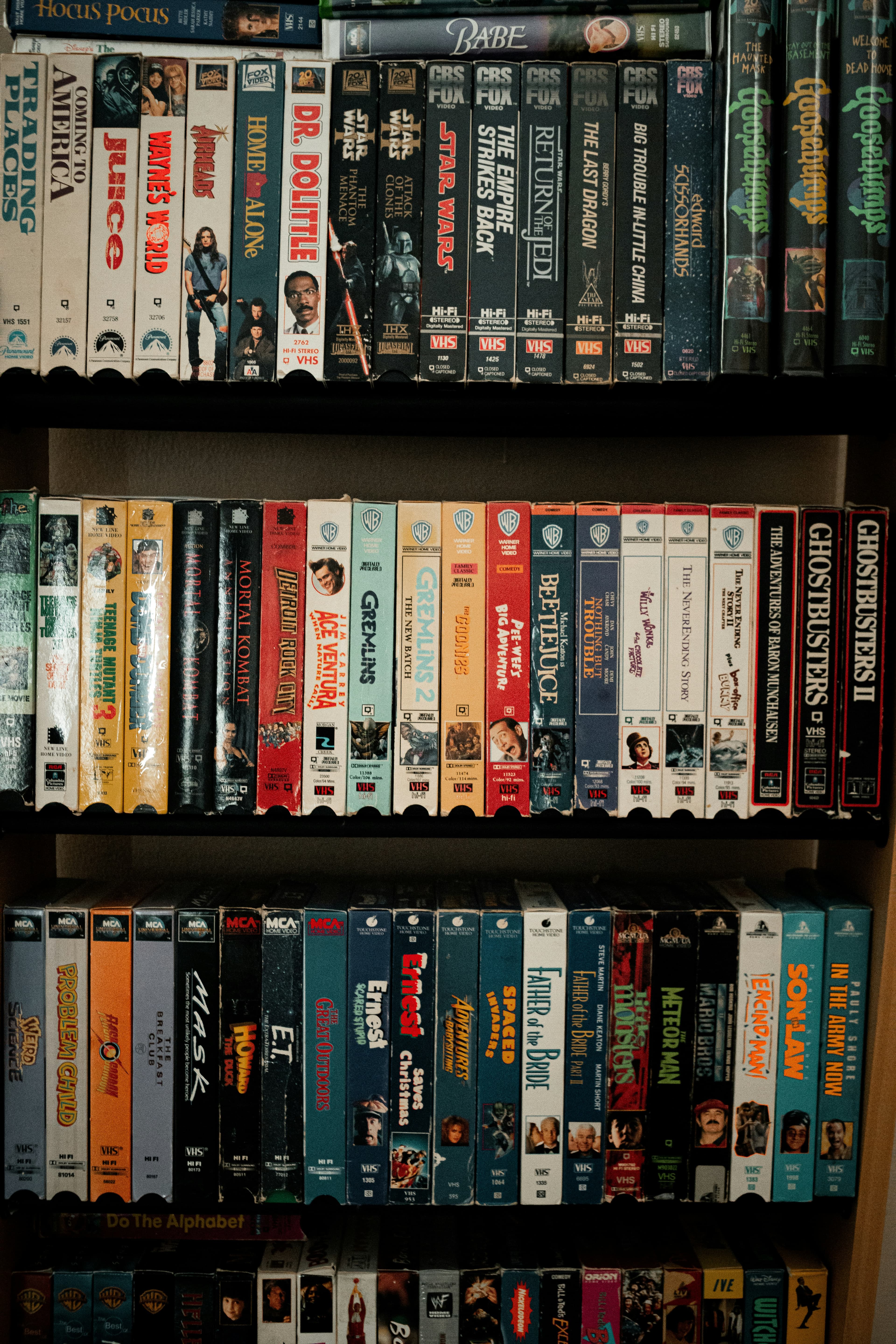
This risk aversion is not merely a matter of creative timidity. As explored in Discovering Cinema's recent series on physical media, it has a structural economic cause: why the mid-budget movie vanished. The DVD and home video market once provided a financial safety net: a long tail of revenue that allowed mid-tier films to slowly recoup costs over time, making the $20–50 million drama or thriller a viable commercial proposition. When the streaming model eliminated that physical media revenue stream, the financial floor dropped away. Without a reliable secondary market to absorb losses, conglomerates retreated to the only two positions that felt "safe": the guaranteed blockbuster at one end, and the cheap genre title at the other. The mid-budget film, often the home of original, writer-led cinema, was a casualty not of audience indifference, but of corporate arithmetic.
Streaming algorithms and the collapse of the long tail
There was a time when we believed the internet would be the "Great Equaliser," breaking the back of the big studios by democratising distribution. This was the premise behind Chris Anderson's influential 2006 book The Long Tail, which argued that digital distribution would make the economics of scarcity obsolete: that platforms hosting thousands of titles would naturally channel audiences toward the niche and diverse content that physical shelves could never accommodate. Curran and Seaton's framework explains exactly this outcome: the internet simply created new conglomerates.
Whilst a streaming service might boast thousands of titles, it often feels like there's "nothing to watch." Why? Because of algorithmic curation. In the absence of any public regulatory framework governing what platforms must surface or support, engagement-optimised algorithms fill the gap with their own logic. As automated gatekeepers, they are built to surface the most profitable, retention-heavy content at the expense of everything else. As we noted in our investigation into the collapse of the "long tail", streaming algorithms concentrate our attention on a few major titles rather than distributing it across diverse voices. The discovery tools that were supposed to deliver on Anderson's promise have instead been quietly optimised for upsell and subscriber retention. The gatekeepers haven't left; they've just traded their suits for hoodies.
Power without responsibility: the film preservation crisis
Perhaps Curran and Seaton's most chilling argument is that media owners exercise power without responsibility. The phrase itself has a longer history than their book. Stanley Baldwin used it in 1931 to attack the press barons Lord Beaverbrook and Lord Rothermere, drawing on a formulation by Rudyard Kipling: the charge that newspaper proprietors wielded the power of kings without being accountable to anyone. Curran and Seaton's title is a deliberate echo of that argument, extending it to the broadcast era, and the streaming era has given it a third life.
Today, we see this not just in what gets made, but in what gets erased. When streaming platforms delete entire shows and films to save money on residuals or take tax write-offs, they create an unprecedented film preservation crisis. Titles that were funded, completed, and briefly available simply vanish, with no physical object, no public archive, and no legal obligation to preserve them.
But deletion is only one form this power takes. Equally troubling is the quiet rewriting of existing films, and it is worth distinguishing between two kinds of alteration, because they tell different stories. The case of The French Connection is instructive here, and worth stating carefully. In 2023, a version of William Friedkin's film began circulating on streaming services with a brief scene silently removed: a few seconds of dialogue establishing the protagonist's racism. The prevailing assumption, though never publicly confirmed by the company, was that Disney, which had acquired the film through its purchase of 21st Century Fox, was responsible for the edit. What made the episode particularly notable was that no announcement accompanied the change: the altered version simply appeared, without labelling or explanation. Later that year, following significant critical and public backlash, the original version was quietly restored to most platforms, again without comment. The whole episode illustrated the problem precisely: a classic film was altered, and then un-altered, entirely at the discretion of its corporate owner, with no consultation, no transparency, and no accountability. As we've explored in depth, streaming platforms can rewrite cinema history with the same unilateral ease.
The altered ending of Fight Club on a Chinese streaming platform is a different, though related, case: there, an external state authority compelled the change. That kind of state censorship is a long-standing concern in media studies, but it is at least visible and attributable. The corporate edit, whether motivated by a licensing dispute, a rebrand, or a cost calculation, is harder to track. Sometimes, as with The French Connection, enough people remember the original that the change gets noticed and reversed. More often, it simply happens, and unless someone who knew the film well was watching closely, nobody knows.
Without physical media acting as an immutable record of what directors actually made, our cinematic history is entirely at the mercy of corporate decisions that may never be acknowledged, let alone reversed.
The solution: pluralism, policy, and independent cinema
Curran and Seaton aren't just telling us that monopolies are bad; they are advocating for pluralism. They argue that for a film culture to be healthy, we need diverse ownership, public service media, and independent spaces that champion the adventurous and socially diverse content that comes from the margins. Crucially, they frame this not as a policy preference but as a democratic necessity: media concentration is a threat to the conditions that make a functioning public sphere possible.
Three regulatory frameworks are currently being developed in response, each approaching the problem from a different angle.
The first is national cultural policy using market access as leverage. The EU's Audiovisual Media Services Directive requires streaming platforms operating in Europe to invest a percentage of their revenue in European content and to ensure that European works make up at least 30% of their catalogues, a baseline that individual member states can and do exceed, with France applying significantly higher thresholds through its own transposition of the Directive. This is an attempt to impose cultural obligations on global platforms by making access to European audiences conditional on contributing to European culture. The UK's streaming levy debate is a version of the same argument: if platforms extract value from British audiences, they should fund British film culture. Neither instrument is perfect: quota obligations don't guarantee quality, and levies can be structured to minimise genuine investment. But they represent a meaningful attempt to use the regulatory leverage that still exists.
The second is platform liability for preservation and alteration. Current frameworks in both the US and UK were designed primarily around user-generated content, and largely fail to address what obligations a platform holds toward the works it funds, licenses, or acquires. Whether a streaming service has a legal duty to preserve a film it commissioned and then deleted, or to disclose alterations to existing works, is in most jurisdictions simply unanswered. Establishing clear obligations here: requirements to archive, to label alterations, to notify rights holders before removal. This would not reverse the concentration of ownership, but it would constrain the unilateral editorial power that concentration enables.
The third is public ownership and commissioning: the argument that some cultural goods are too important to be left entirely to private entities. This is the logic behind the BBC, the BFI, and national film funds, which exist outside commercial logic and are accountable, at least in principle, to a public rather than a shareholder. The Paramount Decrees story is an American one, but the parallel question in Britain is whether public institutions have been adequately resourced and mandated to function as a genuine counterweight to platform power, or whether successive governments have allowed them to diminish precisely at the moment they are most needed.
None of these frameworks, on its own, is sufficient. The jurisdictional problem means that national policy can be avoided by routing through friendlier territories. Liability frameworks require enforcement that rarely keeps pace with platform scale. And public institutions are only as effective as the political will to fund and protect them. But the question is not whether any single mechanism solves the problem; it is whether the combination of all three begins to constitute something resembling accountability. It is exactly the constitutional question Curran and Seaton have spent four decades asking. It is also exactly the question that was answered so badly when the Paramount Decrees were quietly terminated in 2020.
Structural change, though, takes time. In the meantime, the best way to resist the monopoly, and perhaps heed Spielberg's warning, is to seek out what the conglomerates aren't showing you. The lack of variety on your home screen isn't a fluke; it's a feature of a system designed for profit over people. These individual choices won't resolve the structural problem; that requires the kind of political and regulatory will discussed above. But they do sustain the conditions under which a different kind of cinema can continue to exist while the larger argument is won or lost. Supporting your local independent cinema, subscribing to highly curated platforms like MUBI or the Criterion Channel, and actively building a physical media collection are direct ways to encounter cinema that the conglomerates would rather you didn't find.
To discover cinema is to understand who is showing it to you — and why.